Triple Zero Roulette Rules, Odds and House Edge
Triple zero roulette uses 39 pockets and still pays 35:1. See the 7.69% house edge, bet payouts, and what the extra zero costs.
Triple zero roulette uses a 39-pocket wheel but keeps the standard 35:1 straight-up payout, producing a 7.69% house edge and a 92.31% theoretical return to player. For high-stakes players, the third zero is a higher price for familiar bets, not a new way to beat roulette.
The mismatch is visible in the Metropolitan Casinos triple-zero rules document: a selected number hits only 1 time in 39, approximately 2.56%, without a corresponding increase in payout. A large chip doesn't change that relationship. It increases the money exposed to it.
Table of Contents
- What Triple Zero Roulette Actually Costs
- Payouts and Hit Rates on a 39 Pocket Wheel
- How the Extra Zero Compares with Other Wheels
- Even Money Dozens and Inside Bets in Practice
- What High Stakes Volume Does to a Bankroll
- Checks Before You Sit at a 000 Table
- Decide Whether Triple Zero Belongs in Your Mix
What Triple Zero Roulette Actually Costs
A 7.69% house edge on a 39-pocket wheel means the casino retains a larger mathematical advantage while players use familiar chips, bet names and payout conventions. The wheel contains the numbered pockets plus the green outcomes, 0, 00 and 000, while standard straight-up winners still receive the customary payout.
Say a player chooses a table because its minimum and maximum bets fit the intended session. The layout looks familiar, the dealer accepts the stake, and the payout looks normal. Yet the additional green pocket makes the game more expensive without requiring any change in how the player places a bet.
In its 2026 listing, RouletteCalc gives standard triple-zero roulette a 92.31% theoretical RTP, equivalent to about $7.69 of expected loss per $100 wagered over a sufficiently large sample. That's a planning measure, not a promise about what happens to a particular deposit.
Turnover matters more than the deposit
Total wagered means every stake placed, including money won and wagered again. A player can therefore generate substantial betting volume without depositing that same amount.
- Deposit: Money transferred into the casino account.
- Turnover: The accumulated value of bets placed.
- Session result: The actual balance change after wins and losses.
The crypto casino house-edge guide provides context for separating game cost from account balance. That distinction matters when a high roller evaluates rewards based on wagering volume.
Planning rule: Expected loss belongs to the betting volume, not simply to the opening bankroll.
A short session can finish far from the theoretical average, including in profit. Neither the house edge nor RTP specifies the order of results, the size of a drawdown, or the point at which a player will stop.
Payouts and Hit Rates on a 39 Pocket Wheel
Standard triple-zero payouts and hit rates
| Bet | Numbers covered | Payout | Win chance | House edge |
|---|---|---|---|---|
| Straight up | 1 | 35:1 | 1/39 (2.56%) | 7.69% |
| Split | 2 | 17:1 | 2/39 (5.13%) | 7.69% |
| Street | 3 | 11:1 | 3/39 (7.69%) | 7.69% |
| Corner | 4 | 8:1 | 4/39 (10.26%) | 7.69% |
| Six line | 6 | 5:1 | 6/39 (15.38%) | 7.69% |
| Dozen or column | 12 | 2:1 | 12/39 (30.77%) | 7.69% |
| Even money | 18 | 1:1 | 18/39 (46.15%) | 7.69% |
The table applies the standard payout conventions and equally likely pocket model described in Wikipedia's roulette overview, with hit rates calculated as covered pockets divided by total pockets. Its standard-bet calculation gives the same expected disadvantage across ordinary inside and outside wagers, provided no special surrender or imprisonment rules apply.
The important distinction is hit frequency versus expected value. Covering more numbers produces more frequent wins, but the casino pays less for each success. Moving from a single number to a broader bet doesn't remove the mathematical disadvantage.
The straight-up calculation
A straight-up bet is the clearest worked example because it has only a winning number and all the other possible outcomes. Using the payout and probabilities above, the expected net result for a unit stake is:
Expected value = 35/39 − 38/39 = −3/39 = −7.69%.
The positive term represents the profit from a winning result, weighted by its probability. The negative term represents losing the stake on every other pocket.
A payout written as to one describes profit, not the entire amount returned. The winning stake is returned separately. Confusing profit with total return makes the payout appear more generous than it is.
Reading the inside and outside bets
Inside wagers cover particular positions on the betting grid. A split straddles adjacent numbers, a street covers a row, a corner covers a shared intersection, and a six-line spans adjoining rows. The table shows how increasing coverage trades a larger payout for a more frequent hit.
Outside bets cover broader categories: colour, parity, high or low, dozens, and columns. Their labels can sound broad, but the green pockets aren't members of those ordinary categories.
- Even-money categories: Red, black, odd, even, high and low exclude green.
- Dozens and columns: These cover groups from the numbered grid, not the zeros.
- Special top-line areas: Coverage and payout must be read from the actual layout.
A five-number basket is associated with American-style layouts, but its familiar appearance isn't enough to establish how a triple-zero version works. The extra zero may mean the bet is absent or redefined, so assuming the old 6:1 payout is unsafe.
The fair straight-up payout for this wheel would be 38:1. Keeping it at 35:1 is the essential mismatch: the player accepts the additional losing outcomes without receiving a larger prize.
How the Extra Zero Compares with Other Wheels
Single-zero, double-zero and triple-zero wheels
| Wheel | Pockets | Green pockets | House edge | Theoretical RTP | Loss per $100 |
|---|---|---|---|---|---|
| European single zero | 37 | 1 (0) | 2.70% | 97.30% | $2.70 |
| American double zero | 38 | 2 (0, 00) | 5.26% | 94.74% | $5.26 |
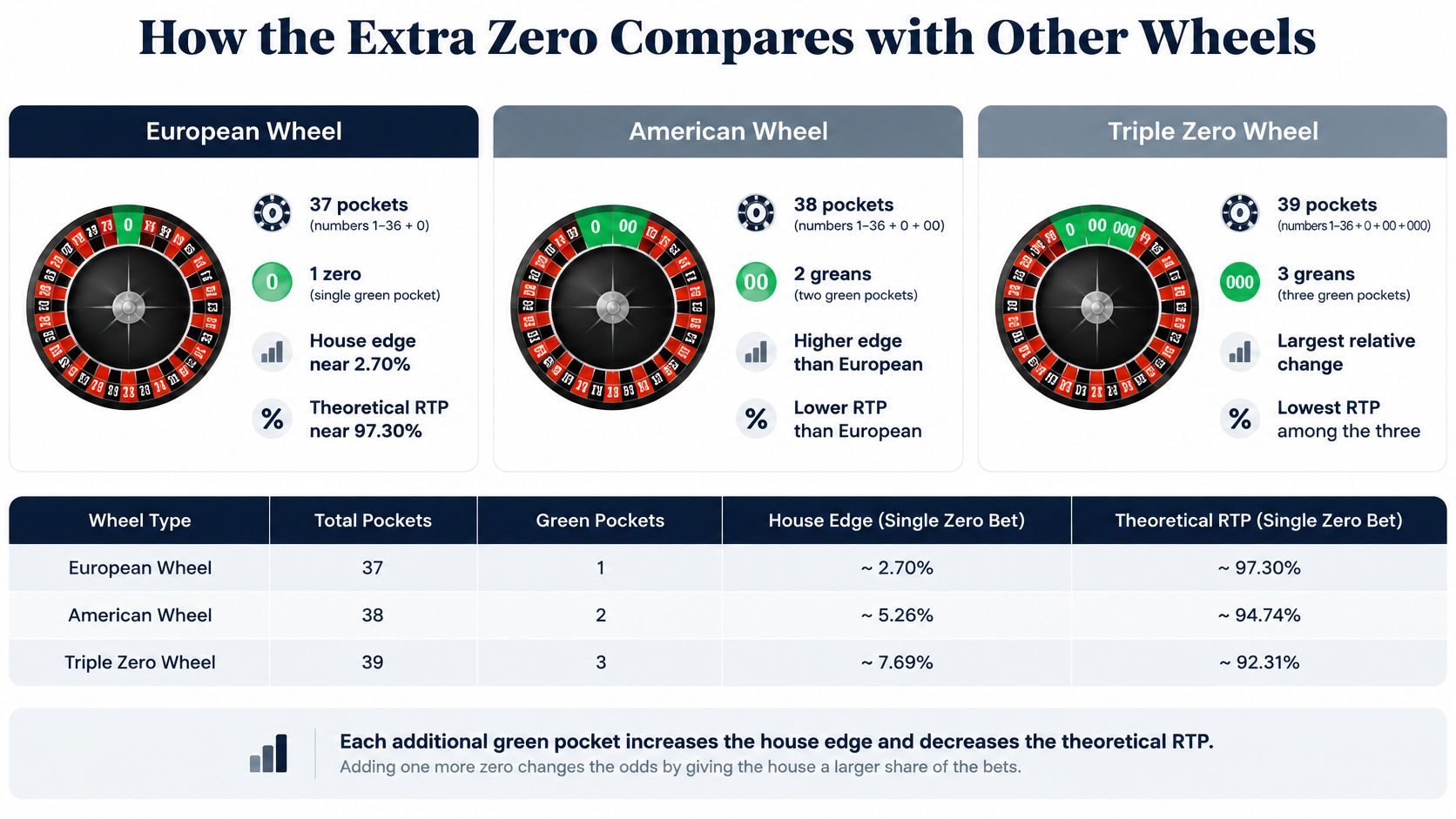
| Triple zero | 39 | 3 (0, 00, 000) | 7.69% | 92.31% | $7.69 |
The standard house edges documented in Wikipedia's roulette article underpin this table; theoretical RTP is the complement of the edge, and expected loss applies that edge to the stated wagering amount. The figures describe standard wheels, with promotional offers priced separately.
Using the rounded rates in the table, the triple-zero disadvantage works out to approximately 2.85 times the European disadvantage, from 7.69% divided by 2.70%. The additional pockets may look like a small physical alteration, but their relative effect on the price of play is substantial.
Against double-zero roulette, the same table puts the triple-zero edge approximately 46% higher, comparing 7.69% with 5.26%. That doesn't mean a particular session loses that much more. It means the expected cost of equivalent wagering volume rises by that proportion.
Compare equivalent games
A useful analogy is a road operator adding another exit at which a driver loses the stake, while leaving the reward at the winning exits unchanged. The player still recognises the route, but the terms are worse.
The comparison only works cleanly when the relevant payout schedules and special rules match. A familiar game name doesn't establish those details, and a premium-looking lobby doesn't make an unfavourable wheel cheaper.
French rules require particular attention. La Partage returns half an eligible even-money stake when zero lands, while En Prison holds an eligible stake under the table's specified rules. Neither protection should be assumed merely because a table offers roulette.
Choose the wheel before choosing the pattern
For a player comparing otherwise equivalent standard games, the single-zero wheel is the cheaper default. Double-zero remains less expensive than triple zero when single-zero isn't available.
The roulette variants comparison helps distinguish the game format from the casino's naming conventions. The decisive checks are the visible zero pockets, the payout schedule and any explicitly stated exceptions.
A player selecting a high-limit table should make that comparison before evaluating chip combinations. Elaborate coverage on the more expensive wheel doesn't substitute for choosing better underlying terms.
Even Money Dozens and Inside Bets in Practice
A flat $100 chip buys a very different ride depending on where it sits on the layout. The paytable still quotes familiar prices, yet every position on this wheel is settled against the same 39 pockets.
In its 2026 explanation, Roulette Universe lists the chance of any green result as 7.69%, or 3 out of 39. Starting from that count makes each bet easy to price: winning pockets on one side, everything else on the other.
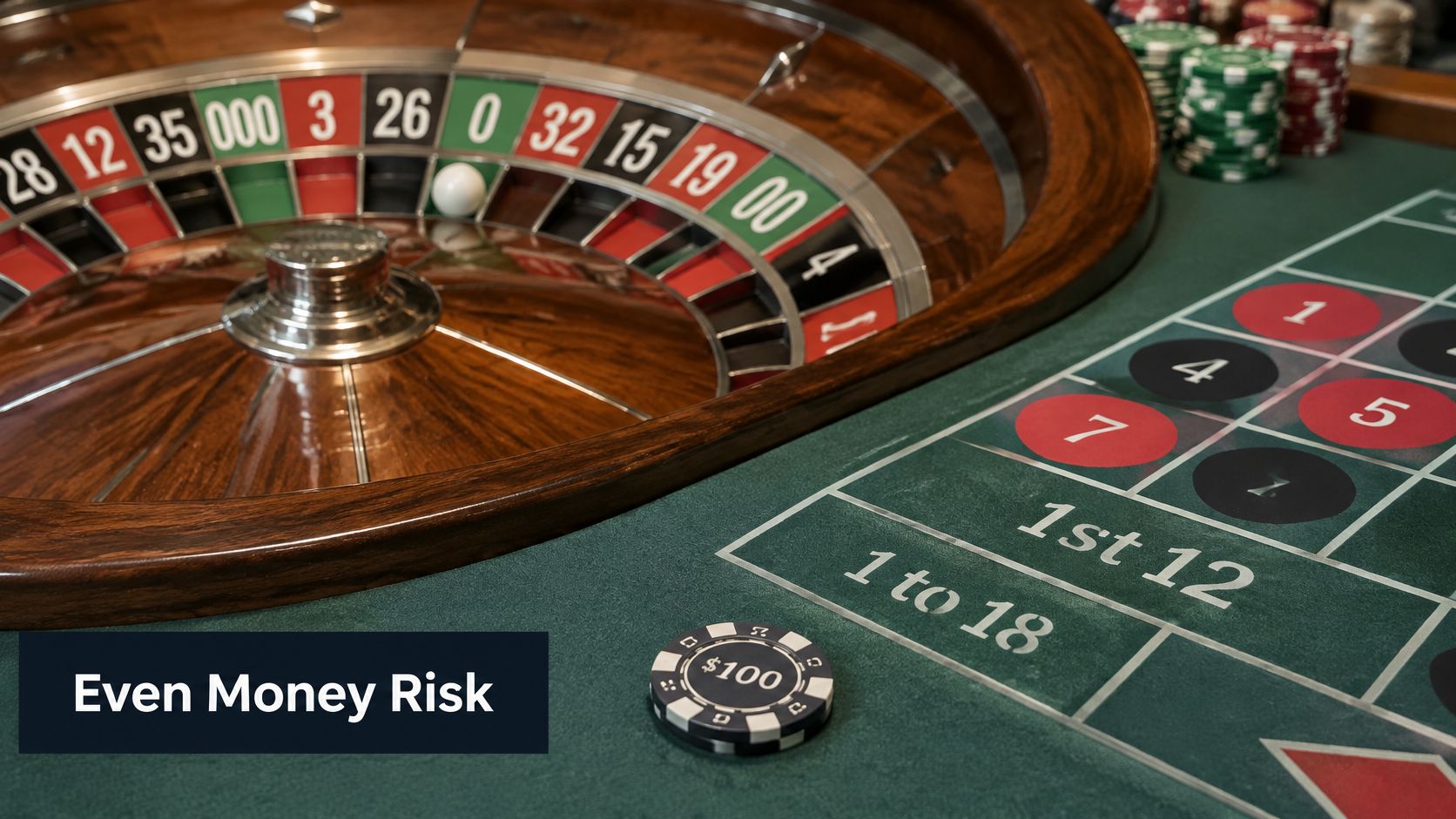
A hypothetical $100 chip used three ways
The following examples apply the standard payout grid to an illustrative stake. They describe possible settlement amounts, not likely session results.
- Even money: A winning red bet produces $100 profit. An opposing colour or green result loses the $100 stake.
- Dozen or column: A winning selection produces $200 profit. Any pocket outside that group loses the stake.
- Straight up: A winning number produces $3,500 profit. Any other result loses the stake.
Count the pockets behind the even-money ticket. Eighteen red pockets pay, and 21 pockets lose: the 18 black ones plus all 3 green ones. The 1:1 price never reflects that losing side.
A dozen or column puts 12 pockets on the player's side and 27 against it, which is what the $200 return is pricing. The straight-up number is the extreme case: 1 pocket pays $3,500 and 38 pockets take the stake. A long run without a payout is fully compatible with the rules, and a large hit doesn't make the number more likely on the next spin.
Coverage changes the experience
A player can combine neighbouring numbers, wheel sections or called bets to build a preferred spread of outcomes. The dealer or interface places several underlying chips, and each one settles on its own terms. Each chip is a separate ticket priced on the same wheel.
Three $100 chips spread across the layout commit $300 to every spin. That arrangement doesn't repair an unfavourable paytable. It changes which results return money and how much is exposed each round.
Outside bets can smooth the pattern of results without making the underlying game cheaper.
What reaches the bill is the total across the layout, not the size of any individual chip. A player who spreads widely may feel protected while handing the wheel $300 of action on every spin, against three pockets that never belong to the bet.
Special baskets and top-line bets deserve a separate reading of the felt. Their coverage must be explicit, particularly where a familiar American-style picture has been adapted to include the additional zero. An unfamiliar bet shouldn't receive a large stake merely because its name sounds familiar.
What High Stakes Volume Does to a Bankroll
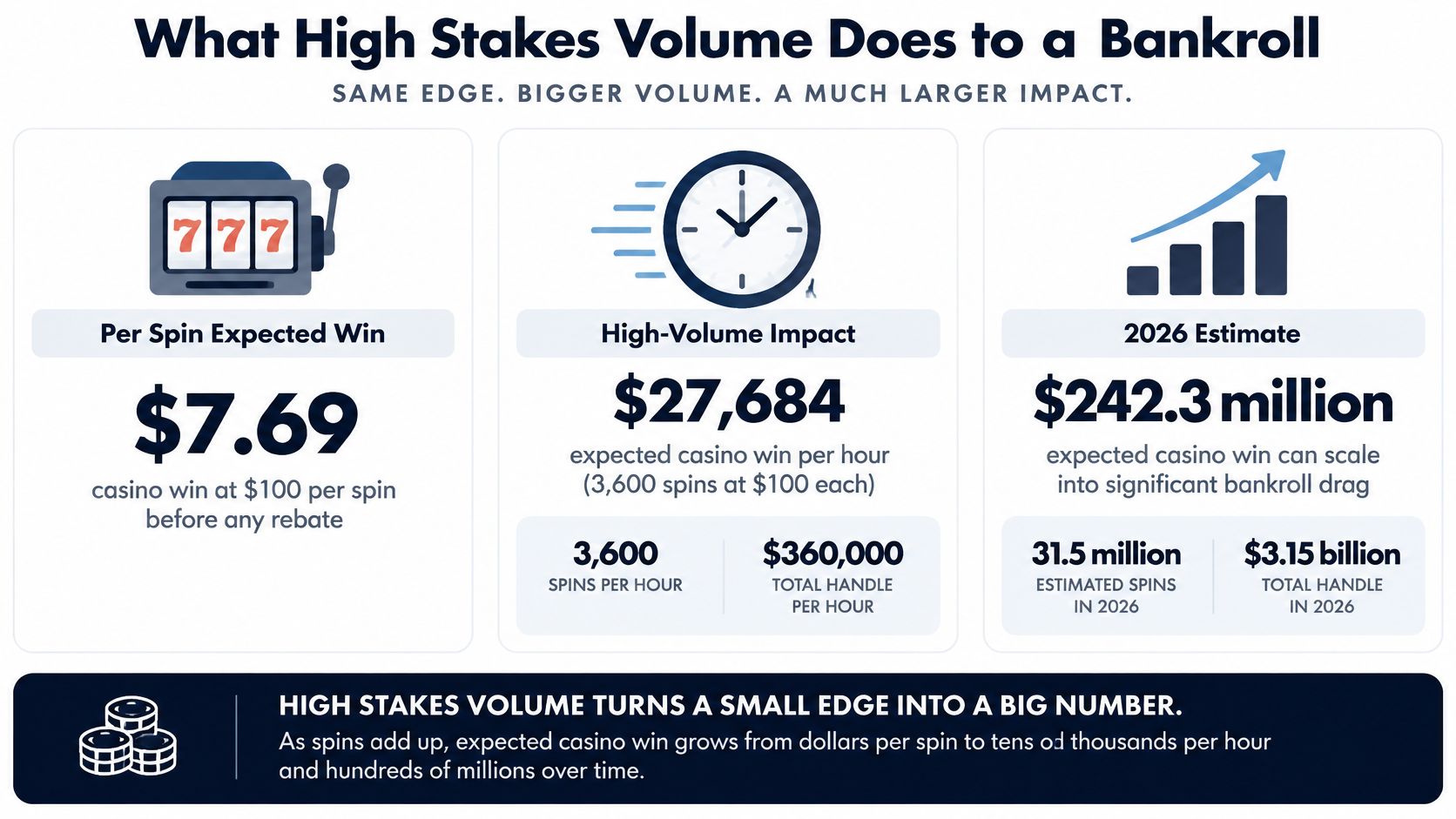
Work from two assumptions: $100 per spin and a steady 60 spins per hour. That puts $6,000 through the layout every hour, and at the standard edge the hour carries an expected cost of approximately $461.
Expected cost works like a meter running on turnover: it charges the same rate whether the session is winning or losing, and it sets no ceiling on what a short session can lose. A slower table lowers the hourly spend while leaving the terms of each spin unchanged.
Separate pace from stake
Hourly exposure has three dials, and each one multiplies expected cost rather than altering the rate applied to it.
- Larger stakes: every spin carries a bigger expected cost at the same edge.
- Faster play: more wagers get priced into the same hour.
- Longer sessions: each extra hour at the example pace adds roughly another $461 of expected cost.
The arithmetic scales cleanly. A $1,000 stake carries an expected cost of approximately $76.90 per spin, and 100 spins at $100 produce about $769 of expected cost on $10,000 of total wagers. Both figures apply the same edge to a chosen volume; neither predicts an actual result.
A bankroll-management plan for high-stakes crypto play fixes the session budget and stake size before the first spin, keeping pace and duration decisions away from the table.
What a rebate actually covers
Rewards check: Published eligibility matters more than the headline cashback rate.
A rebate can offset part of the cost only when roulette qualifies and the calculation is understood. Turnover cashback, loss-based cashback and a share of theoretical casino revenue aren't interchangeable benefits. Each returns a different slice of money already wagered, so the rebate trims the bill rather than changing the price per spin.
Checks Before You Sit at a 000 Table
The label American roulette isn't enough to establish the wheel's pocket count. A player relying on the lobby title can overlook a materially different game behind a familiar name.
A layout photograph, rules panel and live-dealer view should agree. If they don't, a large wager should remain unplaced until the game is identifiable.
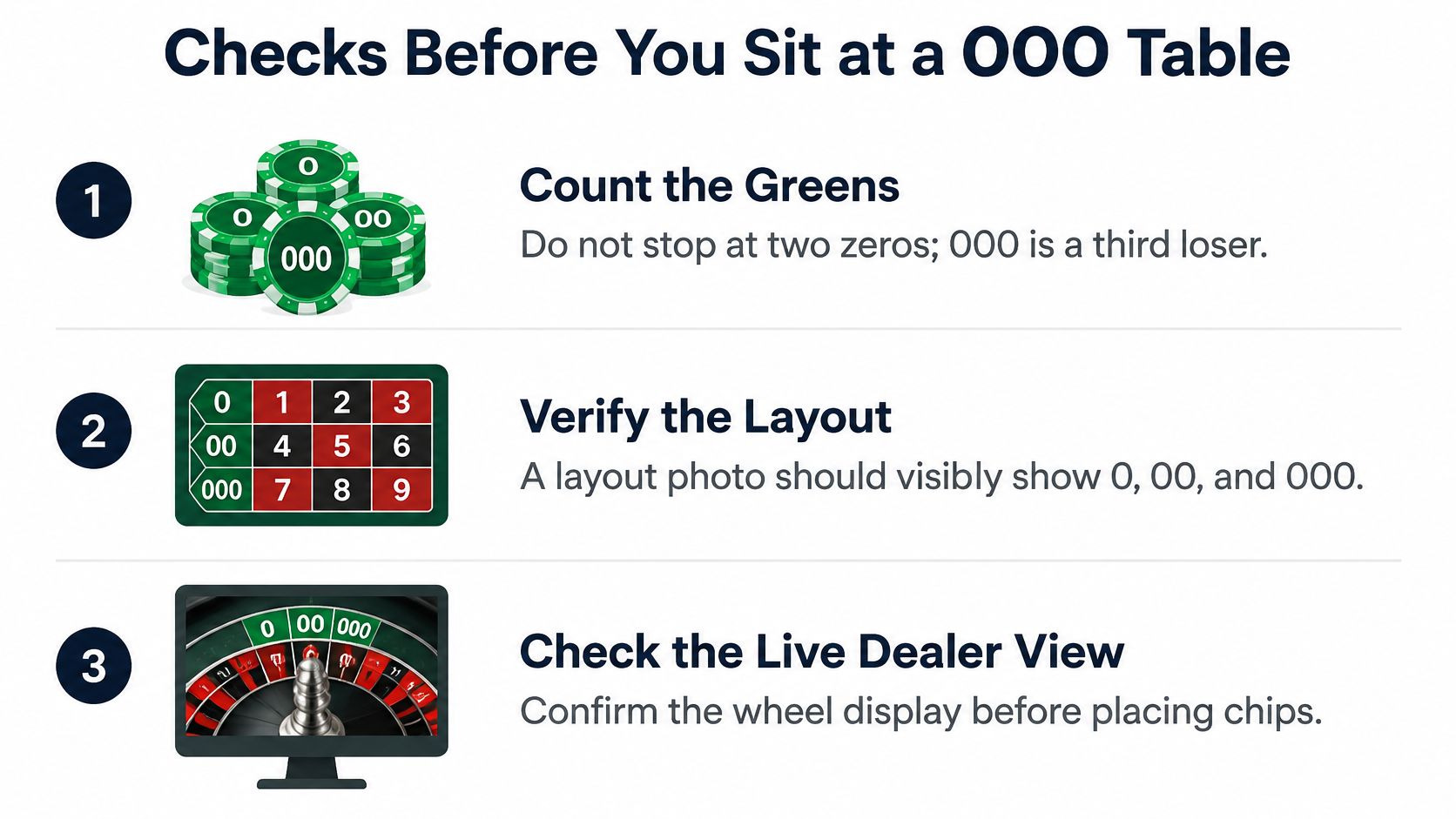
Read the game before funding the action
- Count the greens: The wheel and displayed layout should visibly identify every zero pocket.
- Read the payout panel: Confirm the straight-up settlement and any unusual basket or top-line bet.
- Verify exceptions: La Partage or En Prison should appear in the actual rules, not merely in a general roulette description.
- Match the live view: The active table should correspond to the game described in the information panel.
A payout different from the standard schedule requires its own calculation. Neither a familiar appearance nor a dealer's chip arrangement establishes the expected return.
The same caution applies to rule protections. If the table doesn't explicitly offer a favourable exception, the player shouldn't build a bankroll plan around receiving it.
Keep account restrictions separate
The wheel's mathematics and the operator's account terms answer different questions. The first concerns the expected cost of wagers; the second determines whether a player can place, collect and withdraw the intended amounts.
| Term to inspect | Practical question |
|---|---|
| Table and provider limits | Can the intended stake actually be placed? |
| Maximum-win clause | Can the operator cap a payable result? |
| Withdrawal conditions | Are there instalments, caps or additional review requirements? |
| Verification policy | What documents or source-of-funds checks may apply? |
| Reward eligibility | Does roulette qualify, and how is its activity weighted? |
| Crypto payment terms | Which asset and network are supported for withdrawal? |
A VIP account shouldn't be treated as an exemption from these rules. Written game and account conditions remain more useful than broad claims about unrestricted play.
Progressions don't resolve an unfavourable wheel or a restrictive account. Raising stakes after losses changes exposure and can bring a player to the table cap sooner, without changing the next spin's underlying probabilities.
For large action, HighLimitCasino.io's high-limit comparisons and game guides distinguish table caps, provider restrictions, rule variants and maximum-win clauses. The useful comparison is the effective playable limit, not the largest number advertised in a lobby.
Decide Whether Triple Zero Belongs in Your Mix
By the time a player reaches this decision, the arithmetic is settled. The wheel pays 35:1 on a straight number while drawing from 39 pockets, which raises the expected cost of every $100 wagered and compounds that cost across a high-volume hour. The third zero leaves the paytable untouched; it raises the commission on every bet placed. The wheel comparison earlier in the guide ranks the cheaper alternatives, so the only question left is whether the price buys enough entertainment for the money staked.
Triple zero can still be a legitimate entertainment choice. The test is whether the player accepts the game's price with money that can be lost without affecting financial commitments.
Decide what the third zero costs you
A familiar dealer, a preferred atmosphere or a convenient seat are honest reasons to play. None of them lowers the price of the next spin.
- Take the cheaper wheel on equal terms: where a fewer-zero game runs under the same rules, it returns more of every $100 to the player.
- Size stakes to the budget alone: any cashback arrives after the cost is paid, so it has no place in the stake calculation.
- Require a proven payment record: a table is only as useful as the operator's ability to pay, and withdrawals of $10,000 or more settled without dispute are the strongest evidence that the ability exists.
Withdrawal reliability sits beside game selection for a high roller. An attractive table has limited value when the operator's track record doesn't fit the intended account size.
HighLimitCasino.io evaluates documented terms and withdrawal evidence separately from promotional appeal. Its operator Trust Scores leave out bonus size, and affiliate commissions never determine its rankings.
Stop without needing a recovery result
A losing session creates no obligation to continue, and VIP status leaves the wheel's probabilities untouched. A short winning run is equally poor evidence that the underlying cost has changed. Raising the stake after either outcome raises the hourly cost in the same proportion.
HighLimitCasino.io is an adults-only publication for readers 18 and over, and gambling involves real financial risk. If play stops being affordable or controllable, stopping and using self-exclusion or support resources is more appropriate than changing the betting pattern.
HighLimitCasino.io offers evidence-focused casino reviews, high-limit comparisons and VIP guides covering withdrawal conditions, betting restrictions and reward mechanics. Visit HighLimitCasino.io to compare those terms before committing large stakes to a roulette table.